How to get a refund on an AI subscription
Twenty dollars has gone out for a tool you meant to cancel, or never meant to buy, or somehow bought twice. Almost everyone starts by hunting for the AI company's refund policy. That is the wrong first move, because the rule that governs your money belongs to whoever processed the payment — and for a large share of subscriptions, that is not the AI company at all.
Read the receipt before you read the policy
Find the receipt email before you open anybody's refund policy. Whoever sent that receipt is the party that took the payment — Apple, Google Play, or the provider itself — and that name decides which process you are in, who you write to, what you can ask for, and how long you have. It takes about four seconds to check and it saves you from writing to the wrong company.
The card statement is a slower and worse way to answer the same question, because the line on your statement frequently names the store rather than the tool, which is the exact confusion you are trying to get out of.
That one detail decides everything below.
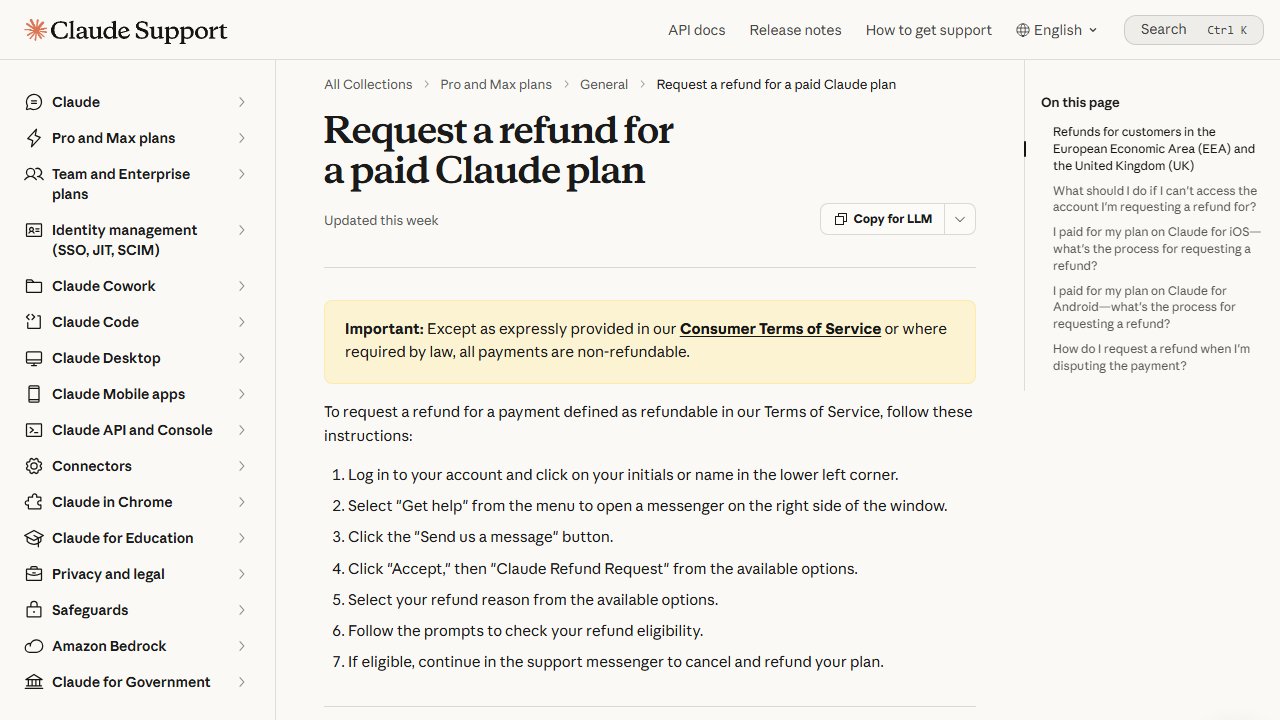
The providers are not coy about this. Anthropic's own refund article says that purchases made in Claude for iOS are handled by Apple, and that only Apple can review and refund them (Anthropic support, checked September 2026). A company telling you plainly that it cannot refund its own product is doing you a favour. It means the queue you need is somewhere else, and the sooner you join it the better.
One wrinkle worth two minutes: it is possible to have subscribed twice to the same tool through two different channels, once on the web and once inside a phone app. If the amount that hit your account is roughly double what you expected, check both places before you write to anyone. We cover the mechanics of finding those in the guide to cancelling AI subscriptions.
Apple took it: Apple decides
The request goes through Apple's report a problem page, at reportaproblem.apple.com, signed in with your Apple Account (Apple support, checked September 2026). Not through the AI company's support form. The AI company, as above, may not even be able to see the transaction.
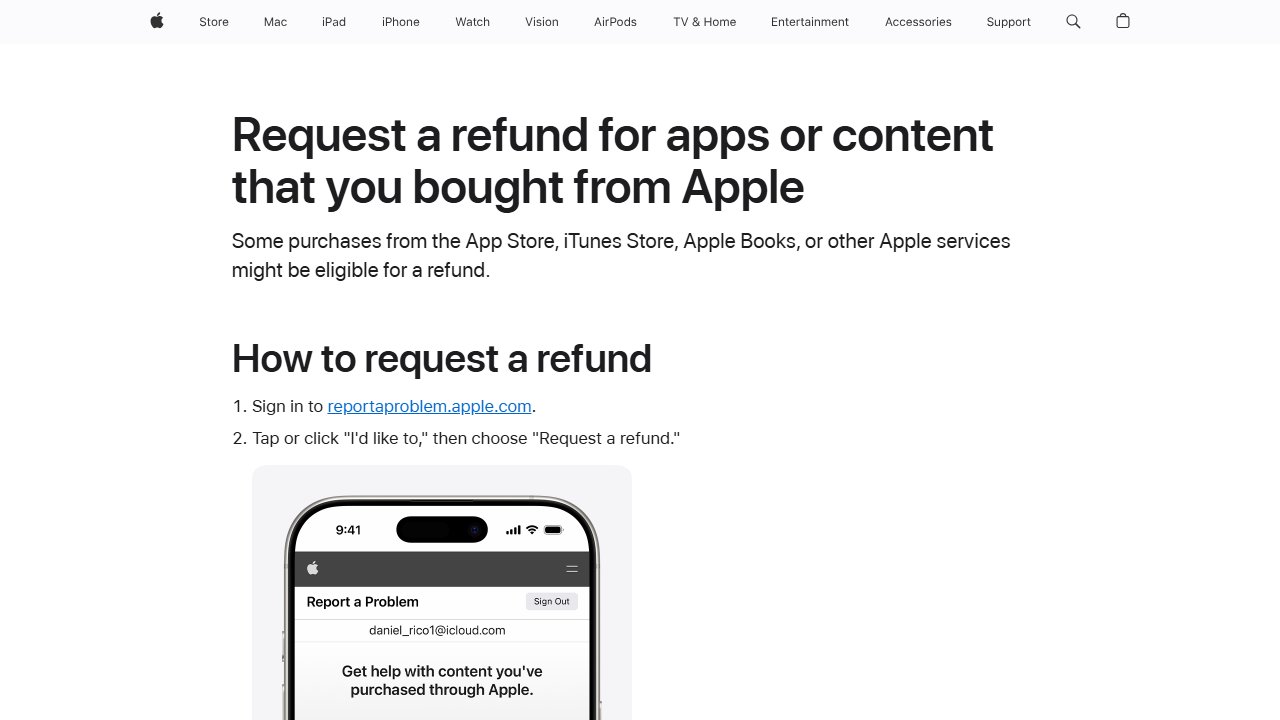
Apple is the one who says yes or no. Its help page puts it in the passive-but-unmistakable form: if your request is approved by Apple, it might take additional time for the funds to return to your payment method. The developer of the app is not in that sentence anywhere.
Now the part that made this section harder to write than it should have been. We went looking for a filing deadline on that page and there isn't one printed. Apple's help page, as of September 2026, does not state a window inside which you have to ask. The one time figure on the page is a wait of 24 to 48 hours for an update on a request you have already submitted, which is how long Apple takes to get back to you — not a deadline for getting to Apple.
So if you have read somewhere that Apple gives you a fixed number of days, do not plan around that figure on our say-so or theirs. Open the page you are actually going to use and read what it says on the day. That is the honest version, and it is also the useful one, because it stops you deciding it's too late to bother.
Last thing here, and it is the mistake we would most like you to avoid: asking for money back does not stop the next charge. Apple's page treats cancelling a subscription as a separate option with its own path. Do the refund request, then go and cancel.
Google Play took it: 48 hours, then it's the developer's call
Google runs a two-stage system and the hinge is at two days.
Inside the first window, Google's help pages say: within 48 hours, you may be able to get a refund depending on the details of the purchase (Google Play help, checked September 2026). Read the hedges. "May be able to" and "depending on the details" are doing real work in that sentence. The self-service path often works; it is never promised.
After that: contact the developer to troubleshoot and find out if you can get a refund. Google's own wording, and it is a real handover — at that point the developer holds the decision. Google's general refund-policy page adds that the developer can process refunds pursuant to its policies and applicable laws, and that contacting the app developer directly is often the quickest way to resolve the issue (Google Play help, checked September 2026).
Two limits on the Play side are worth knowing before you plan anything clever, both of them from the same help page as the 48-hour rule above (Google Play help, checked September 2026):
- You can only return an app or game for a refund once. There is no repeating this trick on the same title.
- If you bought multiple items in one purchase, you can only refund the entire purchase — the whole thing goes back or none of it does.
Put the two stores side by side and the contrast is sharp enough to change your approach. On Apple, the decision stops at Apple: you are asking a store that has no particular stake in whether you liked the product. On Google Play after 48 hours, you are asking the company whose product you are unhappy with, under that company's own published policy. Same phone, same twenty dollars, completely different conversation — and the second one is decided by the terms in the next section.
You paid the company direct: its terms are the whole game
If you typed a card into the provider's website, there is no store standing between you. Whatever the company published is the starting position, and there is no appeal to a third party built into the process.
We read one provider's refund page end to end this round, so we will use it as the worked example rather than generalising from memory. Anthropic's refund article for paid Claude plans says: except as expressly provided in its Consumer Terms of Service or where required by law, all payments are non-refundable (Anthropic support, checked September 2026). That is the default, and it is a firm one.
The exceptions are where your case actually lives. The same page states that in the European Economic Area and the United Kingdom you may receive a refund within 14 days of purchase, and that refunds are prorated according to your use. It also spells out that requesting a refund is not the same thing as cancelling — you have to cancel separately, or the plan renews regardless of how the refund goes.
A hard default no, a regional carve-out, a proration rule, a warning that none of this cancels anything: that is the shape to look for when you open any provider's page. What you have just read is one company's terms; how the others word the same four things is outside what this round covers. Read yours.
Where consumer law overrides a "no refunds" line
A published policy is not the last word everywhere. Consumer protection law can sit on top of it, and the providers know that — the Anthropic wording above carves out "where required by law" before it says anything else.
Where it gets slippery is in the detail, so here is what we can and cannot point at.
The UK government's guidance for businesses selling online and at a distance describes a general right to cancel within 14 days, and anchors that period to 14 days after the order is delivered (GOV.UK, checked September 2026). Delivery is a goods-shaped anchor. A monthly AI subscription is not delivered in that sense, so that sentence does not translate straight into "you have 14 days on your ChatGPT plan". That conversion is the step where most articles on this topic go wrong.
The same guidance says outright that there are different rules for downloads and streaming services, and does not set out those rules on that page. So a separate set of provisions governs digital content, and its text sits outside what this round reached. Treat it as a live question to look up, not a settled one.
One more piece from that page, because it explains a bill you might already have received: if a service has started with the customer's agreement, the business must have told the customer in advance that they would still have to pay a reasonable amount for the use they have had. Which is the legal shadow of that proration line in Anthropic's terms.
A warning about a source you will hit if you search for this. The EU pages about a two-year legal guarantee cover faulty goods and your remedies when something is defective. They are not about changing your mind on a subscription, and using one to argue the other will get you a polite correction from anyone who handles these for a living. The version of "14 days" we can actually point you at is the one a company wrote into its own terms — and a term the company published is far easier to hold it to than a statute you are paraphrasing from memory.
Chargeback: keep it last
Disputing the charge with your bank is available and it sometimes works. It is also the step that ends the conversation.
What happens to your account afterwards is a question with no document behind it. We have no first-hand source on how any of these providers respond to a dispute, and the confident warnings you can find on the subject are, as far as we can tell, nobody's documented policy.
What we will say is procedural. A chargeback is a claim you make to your bank about a merchant, filed after you have stopped negotiating with that merchant. Work the earlier steps first: identify who actually took the money, use that party's own process, and keep the reply in writing. If a store or a provider has refused you on the record, you have something concrete to hand the bank. If you skip straight there, you have a charge and an assertion.
Different situation entirely if you do not recognise the charge at all — a card you have never used with that company, a service you have never heard of. That is a fraud report, it goes to your bank first, and none of the refund routes above apply to it.
Before the next renewal date
Most of what makes refunds painful is decided weeks earlier, at signup.
- Treat refund and cancellation as two jobs. Both Apple's page and Anthropic's say so in their own words, and it is the single most repeated mistake in this whole area.
- Keep the receipt email. It is a filed answer to "who charged me", which is question one every time.
- Subscribe on the provider's website rather than inside a phone app, for anything you expect to keep. This one is our judgement rather than a documented rule: web billing keeps the refund and the cancellation with a company you can email, instead of routing both through a store. The in-app flow is two taps faster and we still think it is the worse trade.
- Put the renewal date in a calendar, two days early. Not on the day — two days early, so a decision has somewhere to happen.
And if this is the third month running that you have had this argument with yourself about the same tool, the refund is not really the thing to fix. The better question is whether the tool has earned its place at all, which is what the subscriptions people most often waste money on and the free tiers worth dropping down to are there to help you answer.
FAQ
How do I work out who actually charged me?
Start with the receipt email rather than the card statement. Whoever sent the receipt is the party that took the payment: Apple, Google Play, or the provider itself. A statement line often names the store rather than the tool, which is the confusion you are trying to clear up in the first place. Providers say the same thing about themselves — Anthropic's refund page states that purchases made in Claude for iOS are handled by Apple, and that only Apple can review and refund them.
Is there a deadline for asking Apple for a refund?
Apple's help page on requesting a refund does not print one, as we read it in September 2026, so we are not going to quote you a number of days. The 24 to 48 hours mentioned on that page is how long to wait for an update on a request you have already filed, not a window to file inside. Read the wording on the page at the moment you use it, because this is exactly the kind of detail that gets edited without an announcement.
Google Play told me to contact the developer. Is that a brush-off?
No, it is the documented route. Google's help pages say that within 48 hours you may be able to get a refund depending on the details of the purchase, and that after 48 hours you should contact the developer to troubleshoot and find out if you can get a refund. Google also says the developer can process refunds pursuant to its policies and applicable laws, and that contacting the app developer directly is often the quickest way to resolve the issue.
Does asking for a refund also cancel the subscription?
No, and that catches people twice in the same month. Apple lists cancelling a subscription as a separate option from requesting a refund, and Anthropic's refund page says in as many words that requesting a refund is not the same as cancelling, and that you have to cancel separately to avoid being charged again. Do both, then reload the billing page and check the renewal line has actually gone.
Nothing on this page is a link anyone pays us for — there are no affiliate or sponsored links anywhere on this site, and we are not a partner or agent of any company named here (our disclosure, how we test). If you are working out where to subscribe from in the first place, that is the payment guide. Help pages move; if a step here no longer matches what you see, the store's or provider's current page wins — and tell us so we can correct it here.
Filed under:Managing Your Subscription